Understanding the 2026-27 Age Group Alignment at EAFC
U.S. Club Soccer has announced a return to calendar-year (Aug 1 - July 31) age groupings beginning next season (26/27). EAFC is aligned with U.S. Club Soccer and is taking a thoughtful, player-first approach to understanding how this change impacts our teams. Our priority remains long-term player development, team continuity, and making decisions that best support each player’s growth. There will be no immediate changes to teams this Spring (2026). We are committed to clear, consistent communication and will share detailed club-wide information as we go through this process.
>>> Scroll down for Parent FAQ >>>
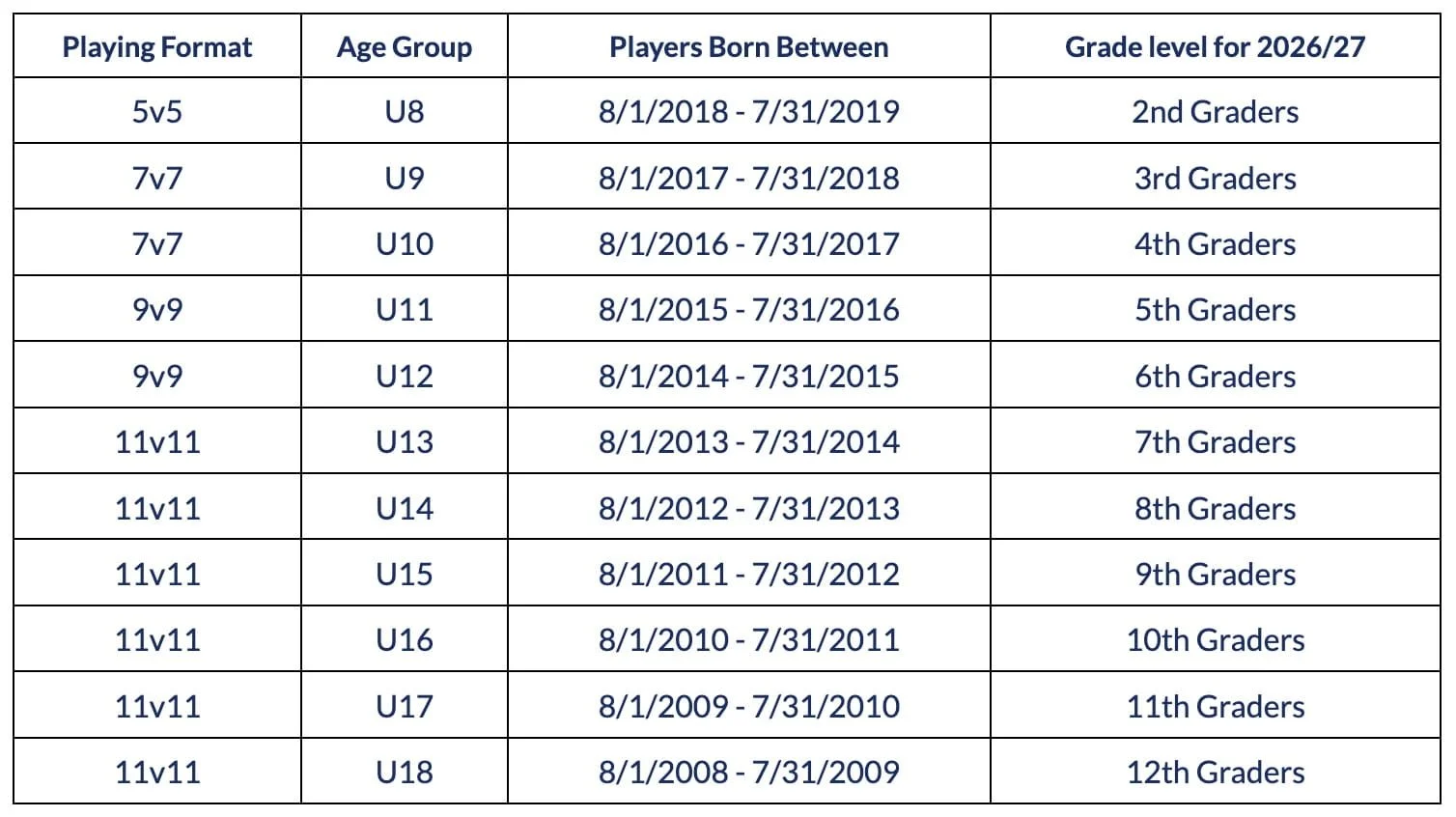
Click here to view our current Age Group Guidelines for 2026-2027
What does this mean for Eastshore Alliance FC?
Beginning with the 2026-27 season, all EAFC teams will align within the August 1 - July 31 age group window. This alignment ensures our teams remain eligible and competitive within leagues such as ECNL Regional League, NPL, local NorCal leagues, and other approved platforms including Junior Allies and Grassroots, while continuing to offer appropriate development environments across all levels of the club.
At EAFC, this shift supports our long-term commitment to player-centered development, clarity in pathways, and strong team environments. We believe aligning age groups more closely with the school year provides meaningful benefits for players and families, including:
Reduced “Split-Year” Team Challenges
Moving away from the traditional birth-year model reduces the number of teams and players affected by mid-year age mismatches (such as isolated 8th-grade situations). This helps create more consistent competitive experiences for players while simplifying roster planning and long-term team continuity.
Stronger Team & Social Cohesion
When players are grouped more closely by school year, teams benefit from improved social connection and shared experiences. This alignment supports healthier team dynamics, leadership development, and a stronger sense of belonging.
Clear Development Pathway
EAFC views this change as an opportunity to further strengthen our player pathway. Aligning age groups by school year better connects the athletic, academic, and social environments our players navigate daily, allowing teams to grow together both on and off the field in a more holistic way.
College & Player Exposure Alignment
Aligning teams by school-year age allows players pursuing collegiate opportunities to compete and be evaluated alongside peers from the same graduating class. This creates clearer timelines and more consistent guidance within our college planning and advisory efforts, supporting players collectively rather than navigating individualized timelines within the same team.
While we believe this change provides significant long-term benefits, we also recognize that transitions can create short-term challenges. Our priority is to approach this process with transparency, empathy, and proactive communication.
As a club, we are committed to ensuring that players, parents, and coaches have clear information, consistent messaging, and opportunities for conversation as we move through this transition together. EAFC will continue to communicate updates, provide guidance, and support each family through this adjustment.
FAQ
-
This represents a practical shift back toward grade-level teams after nearly a decade of using strict calendar-year groupings. The 2017 move to birth-year teams was intended to align U.S. youth soccer with international standards, but in the context of youth soccer in the U.S. it created challenges by separating classmates, complicating logistics for families, and failing to meaningfully reduce relative-age advantages. As clubs prioritized player retention, social development, and consistency with the U.S. school system—where children live, learn, and compete by grade—the benefits of calendar-year alignment proved less impactful than expected. The new cutoff keeps most players grouped with their peers while maintaining a date-based structure, reflecting a broader recognition that youth development models must fit local culture as much as global norms.
-
To better align with school calendars, keeping teammates together, reducing “trapped players” (those older than their school year but younger than their age group), and simplifying college recruiting by matching school and team structures. This reverses the previous birth-year (Jan 1 - Dec 31) system, aiming for more inclusive, social, and developmentally appropriate environments, making it easier for kids to play with classmates and for scouts to identify talent.
-
The birth-year change will require adjustments across all age groups. EAFC is currently reviewing how to best structure teams moving forward, with a focus on development, competitive balance, and long-term player growth.
-
All decisions will be guided by EAFC core values and commitment to :
Long-term player development
Appropriate challenge and environment
Individual growth over short-term outcomes
-
Decisions about player placement will be made by EAFC coaches and in collaboration with their Director of Coaching. Our goal is to ensure each player is placed in an environment that best supports their long-term development, aligns with their age and skills level, and reflects the club’s core values.
-
Our club leadership and coaching staff are actively preparing for the transition. During the spring, we will host grade-level training weeks that allow coaches to observe all players training in their new age groups. Regardless of interest in playing up, it is important that all players train in their grade-level age group during these weeks, as this helps our coaching staff accurately assess player levels within the new age groups.
Our first grade-level training week will begin on February 23, 2026, only current EAFC competitive players in the U8–U15 new age groups will be eligible to take part. Training times and locations will be added to your player’s PlayMetrics calendar.
-
Yes. The expectation is that all players will tryout and compete in their new age group beginning in the 26/27 soccer season. Players will not be permitted to play in a younger age group. In certain cases, players may be considered for placement in an older age group through a formal review process.
If you are an August birthday, please refer to the FAQ “If my child is in a higher grade but born in August, can they play up?”
-
All opportunities for players to play up will be reviewed and recommended solely by the appropriate Director of Coaching and determined on a case-by-case basis, taking into account the player’s development, readiness, and overall team roster needs. Players interested in trying out in an older age group must receive prior approval from the Director of Coaching and will still be evaluated for placement during the club’s official tryouts.
Please review EAFC’s age change guidelines for additional information regarding tryouts in an older age group.
-
We understand that the age group change is intended to better align players with grade-level teams, and that grade-year age groupings may not perfectly match our local school districts.
Players born in August will have the flexibility to choose whether to try out under the new age group format or in the gae group that reflects their grade level. No Director of Coaching (DOC) approval is required for this decision.
All players are still required to try out and earn a roster spot. There are no guarantees of placement on a specific team. As with all tryouts, final team placements are dtermined by the club coaches and Directors of Coaching.
-
As we enter the second and final year of our uniform cycle, we recognize that jersey number conflicts may occur as players transition into new age groups. The club is currently evaluating several options to address this and ensure a smooth transition for all teams. If a jersey number change is required, there will be no additional cost passed on to families. Once we have finalized the best solution, we will provide an update with further details.